Understanding Attributes In MaestroDMX
This section will help you with building or modifying a fixture profile. If you have already retrieved your profiles from the fixture profile website and want to jump to setting up a stage and running a show you can skip forward to 'Stages'.
As you may know, DMX fixture channels have many attribute types. For example, pan, tilt, color wheel, gobo, etc. It is important to understand that MaestroDMX classifies attribute types into either Dynamic or Static. Dynamic attributes are controlled autonomously by MaestroDMX’s intelligent algorithms while Static attributes are set to an editable single value for the lifetime of the Stage.
NOTE: As MaestroDMX develops, the following list will evolve and more attributes will come under the control of MaestroDMX.
Static Attributes
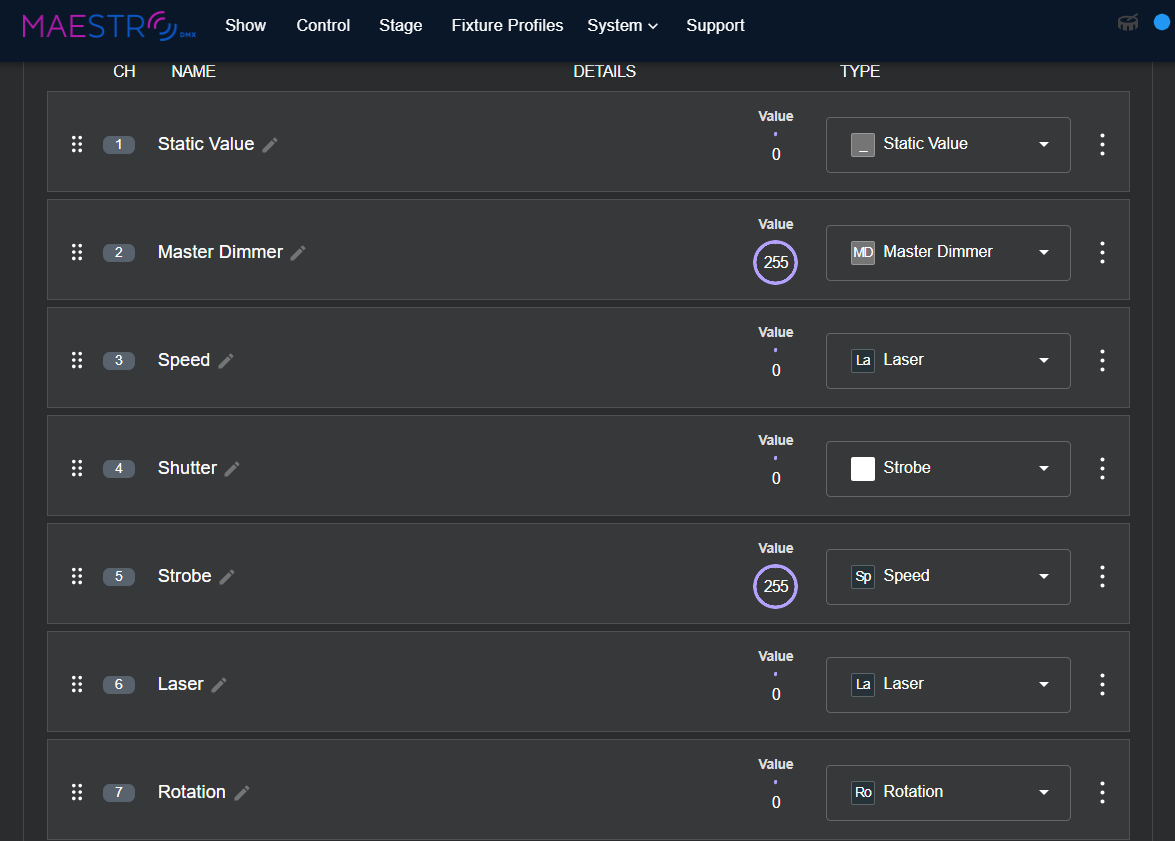
A static attribute will send a constant single value from 0-255 to the fixtures channel. This value can be edited and will be displayed in the fixture profile on the left of the type dropdown menu.
The following attributes are static continuous values:
MASTER DIMMER, STATIC VALUE, LASER, STROBE, ROTATION, SPEED, SHUTTER
Dynamic Attributes
a Dynamic Attribute refers to a parameter type that changes continuously or fluidly—rather than staying fixed. Think of it like a dial or slider that can move through a wide range of values
List of Dynamic Attributes
The following attributes are autonomously controlled by MaestroDMX:
LED Color Control
RED, GREEN, BLUE, COOL WHITE*, WARM WHITE*, AMBER, UV
CYAN, MAGENTA, YELLOW, KEY
HUE, SATURATION, VALUE
*COOL WHITE and WARM WHITE are currently the same attribute
Function
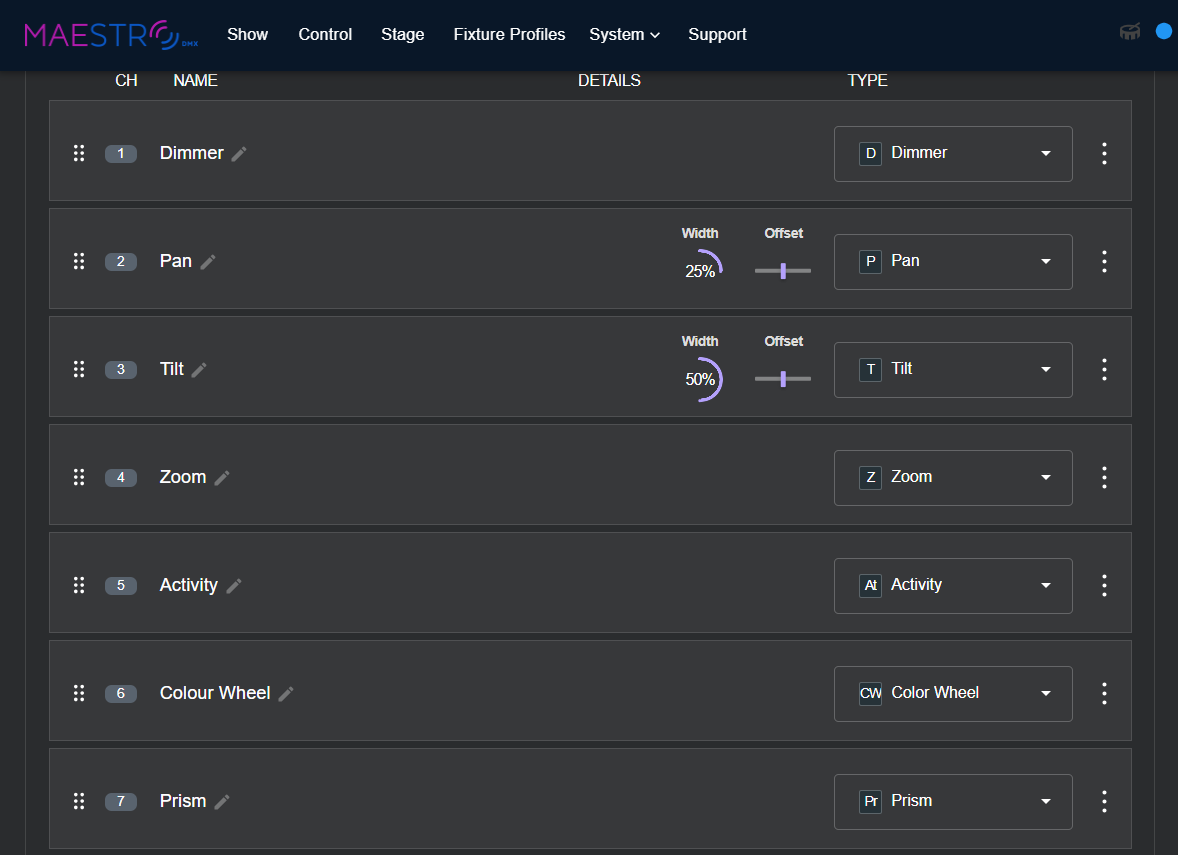
DIMMER, PAN, TILT, ZOOM, ACTIVITY, COLOR WHEEL, GOBO, PRISM, PRESET
Editing Dynamic Attributes
For all Dynamic types: PAN, TILT, ZOOM, ACTIVITY, LED Color Control, etc you can define the following Attribute Properties:
Output Range: Limits the range in which this channel can operate.
Smoothing: This will add more steps to a channel which can help if movement or colour fading feels clunky. This will slow down the dynamic speed of the attribute.
Invert Value: This will invert the channel data eg 1-255 will be 255-1
Note: Maestro will add mirroring and symmetry automatically, you likely will not need to invert at the attribute level (such as pan/tilts on movers).
Uniquely to PAN and TILT types you can define the following Attribute Properties:
Offset: defines the pan or tilt center point
Width: defines the pan or tilt range of motion around the center point
For Effect button control types:
ON: Only available for FOG, BLACKOUT and EFFECT channel types. When triggered via the SHOW page’s Trigger Button, the ON value will be set
OFF: Only available for FOG, BLACKOUT and EFFECT channel types. When triggered via the SHOW page’s Trigger Button, the OFF value will be set
Trigger Attributes
FOG ON/OFF, FOG VOLUME, FOG SPEED, BLINDER, EFFECT, BRIGHTNESS
The ‘Blinder’, ‘Blackout’ and ‘Effects’ attributes can be controlled in real-time via the corresponding Trigger Buttons on the Show page.
Using the ACTIVITY Attribute Type
The Musical Activity Level, as viewed on the Audio page, is directly connected to the ACTIVITY attribute type. This gives you the ability to connect a measure of how exciting the music is to any DMX channel. For example, you could set ACTIVITY to:
The rotation speed of a fixture(s) to have it speed up and slow down with the music.
The dimmer levels of a group of fixtures have them get brighter or darker with the music.
The intensity or movement of a laser effect.
Using MASTER DIMMER vs DIMMER vs BRIGHTNESS Types
When looking at the built-in fixture profile you will see that both MASTER DIMMER and DIMMER attribute types are used. When the MASTER DIMMER type is used, it is generally set to ‘255’ when a fixture mode has a dimmer channel along with LED color channels such as RGBW, etc. In this case, MaestroDMX takes care of the dimming via the levels of the color channels. This can be useful to set the relative brightness between fixtures.
However, if you are using a fixture profile with a dimmer channel AND it uses a color wheel and does NOT have any LED color control (RGBW etc), then the DIMMER attribute type is used. The DIMMER type is intelligently controlled by MaestroDMX and will pulse the dimmer on the fixture in sync with the music.
The ‘Global Brightness’ located on the top of the ‘Show’ is directly mapped to the BRIGHTNESS attribute. Giving users the ability to control any DMX channel with the ‘Global Brightness’ slider.
Using GOBO and PRISM Types
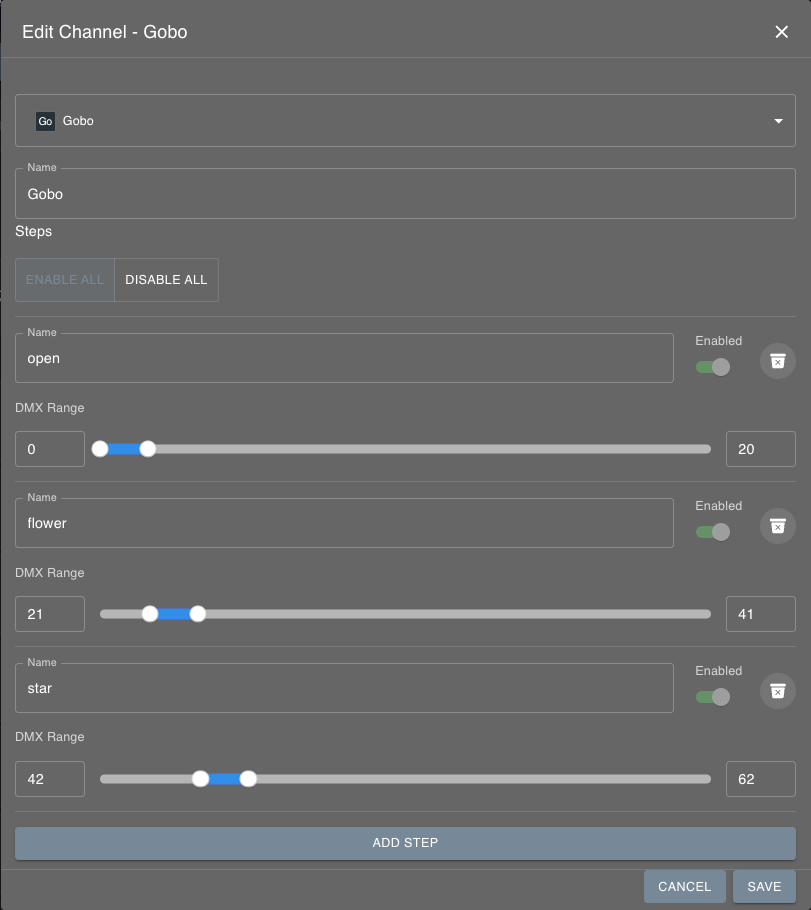
MaestroDMX allows autonomous control of GOBO and PRISM attribute types. Before a GOBO or PRISM channel can be controlled by MaestroDMX, the GOBO and/or PRISM channels of your fixture profile must have steps defined. The specific ranges can be found in the fixture profile’s DMX specification available from the manufacturer.
A step has the following properties:
The name of the specific gobo or prism effect at a specific DMX channel value.
A range of DMX values correlates to the effect.
Enabled toggle status.
Use ‘ADD STEP’ to add a new step and click the garbage icon to remove the step. Be sure to SAVE once you have made changes. The image below shows an example of the GOBO channel, however, the setting up of a PRISM channel is the same.
NOTE: Use ‘ENABLE/DISABLE ALL’ to toggle the gobo steps as needed.
Once your GOBO and/or PRISM channels are configured, MaestroDMX will autonomously trigger the steps based on changes in the music.
Using COLOR WHEEL Types
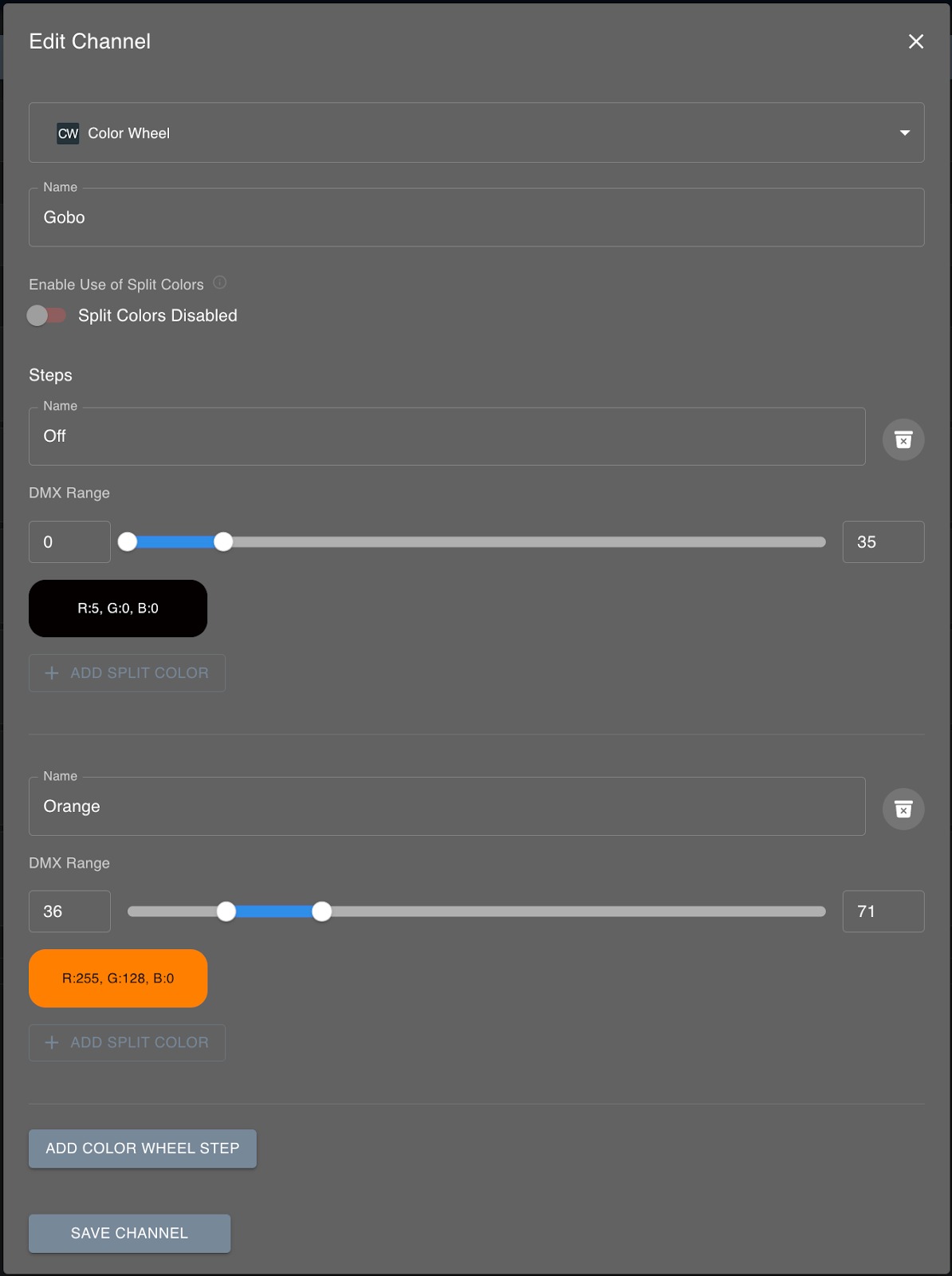
As of software v1.1 MaestroDMX allows autonomous synchronization of a fixture's COLOUR WHEEL attribute to the internal RGB colour space. Before a COLOR WHEEL channel can be controlled by MaestroDMX, the COLOR WHEEL channel of your fixture profile must have color wheel steps defined. To define a color, you must set the DMX range and choose a close representation of the color from the color picker. The specific colors for each step can be found in the fixture profile’s DMX specification available from the manufacturer/user manual.
NOTE: As of software V1.2 the COLOR WHEEL attribute is being used for any channels that have colors specified such as: Color Wheels, Derbys, and Lasers.
Use ‘ADD STEP’ to add a new step and click the garbage icon to remove the step. Be sure to SAVE once you have made changes.
Follow these instructions for defining a colour step
Give the colour a name for your reference.
Using the manuals specifications, define the DMX range each step uses.
Select a colour from the colour picker for MaestroDMX to read. The colour picker has HEX, RGB and 14 common colours to help you define the colour.
Add a split colour for lights that use multiple colours in single steps.
Once your color steps are defined, MaestroDMX will autonomously synchronize the colors on your COLOR WHEEL channel with the internal color palettes.
Dealing With Undefined Colours
Some fixture manufacturers do not define the color at each step, i.e. the manual may say ‘color 1, color 2, color 3…etc’. In this case, you will have to visually discover the colors by putting the fixture on your stage and using the Override Channel Value in the colour wheel editor. This way you can visually verify and take note of the colors at each step. When each step is defined you can save this mode to the existing profile. Read more in Patcher: editing fixtures in a stage.
Was this article helpful?
That’s Great!
Thank you for your feedback
Sorry! We couldn't be helpful
Thank you for your feedback
Feedback sent
We appreciate your effort and will try to fix the article